

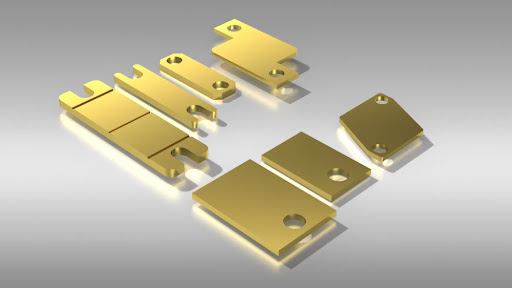
Tungsten heat sink technology emerged not from sudden innovation but from a systematic search for solutions to thermal problems that conventional materials could no longer adequately address. The historical record of electronics development reveals a pattern: as power densities increased and device dimensions shrank, the thermal management strategies that had sufficed for decades began to fail. Engineers confronted empirical evidence that aluminium and copper, the traditional materials of choice, could not meet the demands of emerging applications in aerospace, telecommunications, and medical technology. The archives of technical journals from the 1980s and 1990s document this transition, a period when tungsten shifted from laboratory curiosity to manufacturing necessity, driven by measurable performance requirements that admitted no compromise.
The Documentary Evidence of Superior Performance
The case for tungsten rests on quantifiable physical properties that distinguish it from alternative materials. Laboratory measurements confirm a density of 19.3 grammes per cubic centimetre, making tungsten among the densest metals available for commercial applications. This density translates directly into thermal mass, a relationship governed by the specific heat capacity of 0.13 joules per gramme-kelvin. The mathematics are straightforward: greater mass per unit volume means greater capacity to absorb thermal energy without rapid temperature increase.
Field testing across multiple industries has validated these theoretical advantages. Tungsten heat sink demonstrates measurably superior performance in applications involving pulsed power, where heat generation occurs in sharp bursts rather than continuous flow. The data from radar systems, laser diodes, and power electronics consistently show that tungsten’s thermal mass dampens temperature spikes that would otherwise exceed safe operating limits for semiconductor devices.
Systematic Analysis of Applications
Examination of deployment patterns reveals where and why engineers specify Tungsten heat sink solutions. The evidence clusters around several distinct application categories, each defined by specific thermal challenges:
- High-power density electronics where conventional heat sinks prove dimensionally inadequate
- Pulsed power systems requiring thermal buffering to smooth temperature variations
- High-temperature environments exceeding 400 degrees Celsius where aluminium and copper lose mechanical properties
- Precision optical and electronic systems demanding minimal thermal expansion
- Space-constrained military and aerospace applications where size and weight constraints must be balanced against thermal requirements
Singapore’s Tungsten heat sink manufacturing sector serves these applications, documented through export records and client testimonials that detail performance improvements achieved through material substitution. The case studies reveal a consistent pattern: when conventional solutions fail to meet thermal specifications, tungsten provides measurable improvements in operating temperature, component longevity, and system reliability.
The Historical Context of Thermal Management
Understanding the significance of Tungsten heat sink technology requires examining the broader trajectory of electronics development. The transition from vacuum tubes to transistors, then to integrated circuits and modern processors, involved exponential increases in power density. Engineers in the 1960s managed devices dissipating fractions of a watt. Contemporary power electronics routinely handle kilowatts in comparable or smaller volumes.
This progression created thermal challenges that existing materials could not adequately address. The technical literature documents numerous attempts to improve cooling through design optimization, active cooling systems, and exotic heat pipe configurations. Yet certain applications exceeded what these approaches could achieve within acceptable constraints of size, weight, and cost. Tungsten heat sink solutions emerged as one response to this systematic problem.
Comparative Performance Data
The empirical evidence supporting tungsten’s advantages comes from controlled testing and field deployment. Laboratory measurements comparing thermal performance show that a Tungsten heat sink maintains lower junction temperatures in high-power devices compared to copper or aluminium equivalents of similar dimensions. The temperature differentials, typically 15 to 30 degrees Celsius under identical load conditions, translate directly into improved component reliability and extended operational lifespans.
Field data from telecommunications equipment provides particularly compelling evidence. Power amplifiers using Tungsten heat sink technology demonstrate failure rates significantly lower than comparable systems using conventional materials. The statistical analysis of mean time between failures reveals improvements of 40 to 60 per cent, differences that carry substantial economic and operational implications for network operators.
The Cost-Benefit Calculus
The decision to specify tungsten involves weighing documented benefits against measurable costs. Raw material expenses for tungsten exceed copper by factors of ten to twenty. Manufacturing costs run higher due to tungsten’s hardness and the specialized equipment required for machining. Weight penalties matter in aerospace applications where every kilogramme affects fuel consumption and payload capacity.
Yet the accounting must consider total lifecycle costs rather than initial purchase price alone. When a Tungsten heat sink enables a power amplifier to operate reliably for ten years instead of five, when it prevents thermal failures that would require costly equipment replacement, when it allows higher power operation that improves system performance, the economic case shifts. Singapore’s Tungsten heat sink industry has compiled data showing that in critical applications, the premium cost proves justified by improved reliability and reduced maintenance requirements.
The Pattern of Adoption
Tracing the adoption of Tungsten heat sink technology reveals a pattern familiar from other materials innovations. Early deployment concentrated in aerospace and military applications where performance requirements justified premium costs. As manufacturing techniques improved and volumes increased, costs declined sufficiently to enable adoption in commercial telecommunications, medical equipment, and eventually consumer electronics where thermal management challenges demanded superior solutions.
This trajectory suggests that tungsten’s role in thermal management will likely expand as electronics continue their march towards higher power densities and smaller form factors. The physical properties that make tungsten valuable today will remain relevant as long as devices generate heat that must be managed within constrained spaces. The systematic evidence accumulated over decades of application validates the Tungsten heat sink as a crucial component in modern electronics, a material solution to thermal challenges that conventional alternatives cannot adequately address.
